Period · until c. 1600
Renaissance
Many voices, one breath.
What it was
The music of monasteries, courts and cities up to about 1600: Gregorian chant, polyphony, in which each voice sings a line of its own, the motet, the madrigal and court dances. In this era notation settles and printing begins to spread scores across Europe.
Ideas of the period
- Polyphony
- Imitation between voices
- Old modes
- Singing without accompaniment
- Notation and printing
Curiosities
- 1501 Ottaviano Petrucci publishes in Venice the Harmonice Musices Odhecaton, the first book of polyphony printed with movable type.
- c. 1025 The names of the notes (ut, re, mi, fa, sol, la) come from a medieval hymn and are usually credited to the monk Guido of Arezzo.
- c. 1525–1594 Palestrina wrote more than a hundred masses; the way he leads the voices became a model of counterpoint still studied today.
- Lute The favourite instrument of the salons was written in tablature, with letters and numbers showing where to put the fingers, not notes.
Composers of the period
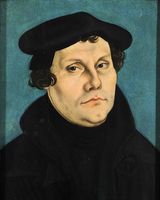
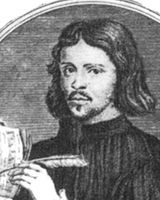
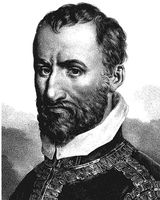
Born before 1570 (the app's cut, by birth year). The composer profiles are in Portuguese.